
Welcome to Transcendence. A sixteen‑chapter story revealed weekly.
Prolog – Foundation
“Should a newly discovered world prove habitable, it should not be claimed, but welcomed. And when we engineer one to start our expansion — one day we will — I always thought ‘Hestia’ would be a good name, with a good heritage.”
— Dr. Neil deGrasse Tyson, A Life of Universe’s Conundrums, 2061 TC
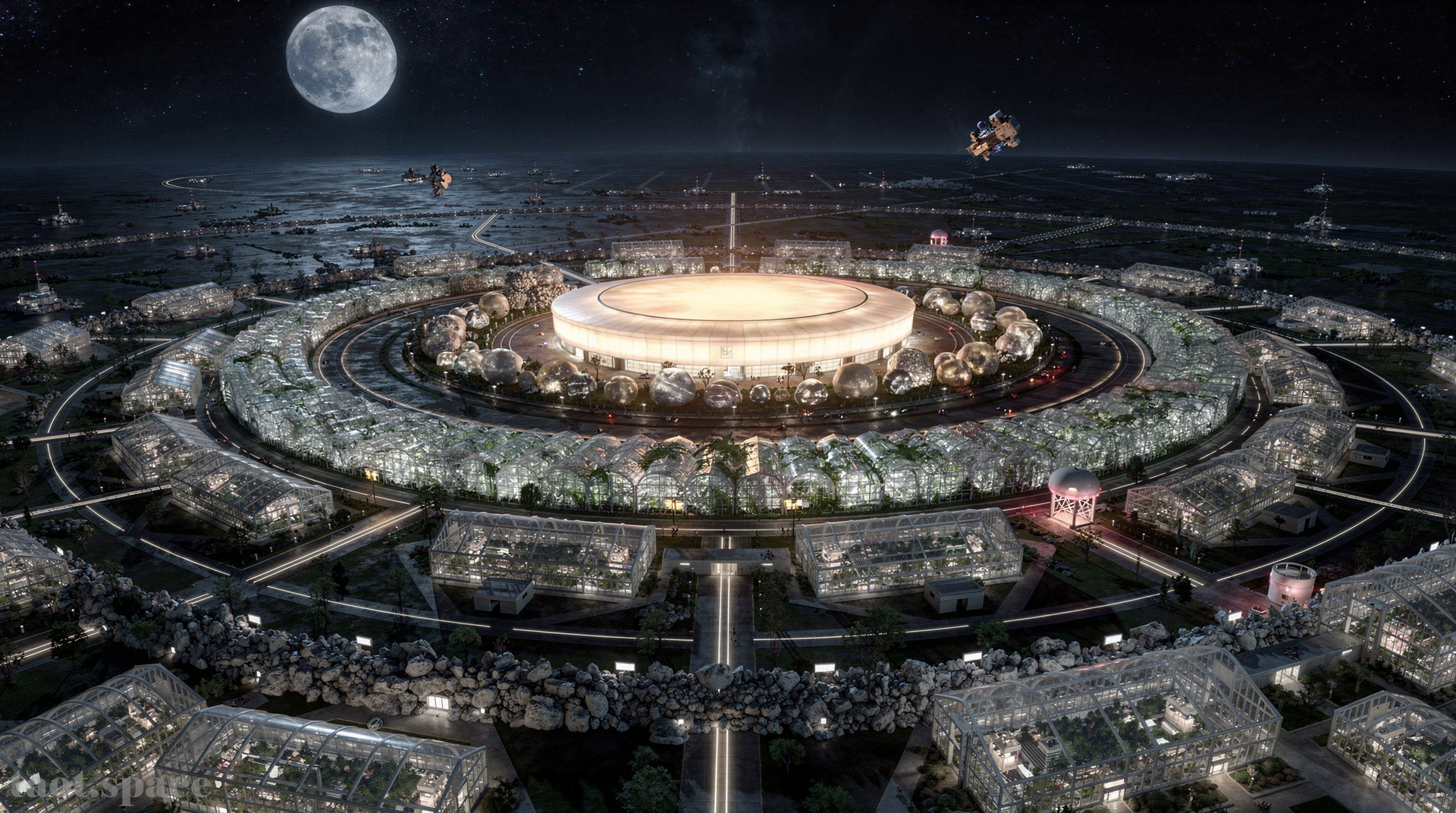
The sun moves slowly toward its resting place behind the horizon, letting the moon rule the sky, with the stars as witnesses. The Space Exploration Expansion Technology, or SEET, compound is always quieter for a couple of weeks prior to important launches.
An aerial view of the compound reveals a concentric layout, a design with military DNA, with efficiency as its primary purpose. Similar houses, with almost carbon‑copied yards covered by lawns mowed with mathematical precision. The access routes are as straight and direct as possible, leading to any of the administrative buildings and, of course, the center. There is the main central building; it is circular, and it is so large that almost all of the residential neighborhoods could fit inside it.
Coincidentally or not, when the compound was completed, something interesting was discovered by one of the TV stations. The compound layout represents the entire solar system: the Sun in the center, surrounded by the solar system’s planets: the residential zones. Pretty simple, very well received, and innocent news, which fit nicely with SEET’s announced purpose and scope. But no one expected it to become a sensation that would “break” the internet. Space and astronomy enthusiasts presented clear mathematical data showing that the entire complex was uncannily in scale. They pointed out details such as Earth’s Moon and the two or three largest satellites of Saturn and Jupiter. Even the supporting greenhouses and farms were identified as a section of the asteroid belt.
Since then, SEET has completed hundreds of projects and thousands of successful launches. The two weeks of quiet nights prior to a launch evolved into tradition, a time offered to the universe to prepare for the upcoming mission. This is the fourth week of quiet nights. Not because the initial launch date was postponed. That never happened at SEET. It is because this is the most challenging and complex project SEET has ever worked on. It is far more than a probe, a new type of telescope, the assembly of a new habitat module on GODS2, the second Global Orbital Development System, or a resupply mission to Mars.
This time, it is something never attempted before. Over twenty years of research led to countless tests performed repeatedly until the results were exactly as needed and predicted. The Hestia Colony Project is the final project closing one thousand years of preparation.
Hestia… the tenth planet of the solar system. The planet no one foresaw was coming; the planet that reignited hope for human survival, making it possible, for the first time in history, to reunite humanity on a global scale. And yet, its name had already been set, somehow predicted, for over fifteen hundred years.
In the early twenty‑first century, when Earth still looked like Earth, nearly twenty years were spent hunting the elusive Planet Nine. That effort eventually paid off. Planet Nine was found beyond Uranus, moving slowly around the Sun.
It took the International Astronomical Union a few weeks of debate to set the planet’s official name: Hermes the Messenger of the Gods, the solar system’s guardian planet. Dr. Neil deGrasse Tyson played a role in validating the discovery as a planet and in its naming. This was recorded as his last official duty before retiring. The news spread quickly:
“Dr. Tyson’s redemption has come. He can now retire with a clean planetary slate. Pluto out. Hermes in.”
Later, in his final work, A Life of Universe’s Conundrums, published shortly after Halley’s Comet returned in 2061 TC (Terran Calendar), Tyson, reflected on how future astrophysics would be forced to answer questions not yet comprehensible, opening new horizons and entirely new branches of science. When Halley’s Comet returned in 2061, Dr. Brian Cox, at a cosmic 93 years into his journey around the Sun, stood beside Dr. Neil deGrasse Tyson, at a universe‑curious 103 years, both men witnessing the sky they had spent their lives teaching us to love.
Hestia, a rogue planet discovered while passing by Uranus, forced humanity to pause and reconsider its priorities and its future. A new cosmic home. A new Earth, a chance to begin again and avoid repeating history’s mistakes. The approval of the Orbital Planetary Capture program marked the beginning. The Hestia Colony Project became the construction of that future, a century‑long endeavor, the longest ever recorded in human history.
There was a long road ahead before Hestia could truly welcome humanity. To meet that challenge, Programmable Autonomous Robotic Equipment (PARE) was developed. intelligent machinery capable of performing almost any task, depending on the program loaded. Once activated, a unit could evaluate a task, select the appropriate tools, and execute it. Early versions were efficient, but once a task was completed, the next program had to be triggered from Earth.
Later generations introduced preloaded programs that could self‑activate based on situational needs, reporting back to Earth only when no internal solution could be found. Many versions followed, each granting increased autonomy and efficiency.
PARE technology made possible the construction of power generators, atmospheric composition control systems, and the towers designed to mend Hestia’s weak natural electromagnetic field. These were critical steps in Okiogenesis, a process adopted in place of the old, brutal idea of “terraforming.” And now, here at SEET, preparations are underway for the mission that will mark the one‑thousandth anniversary of the Hestia Colony Project, culminating in a series of synchronous launches on the anniversary day.
Leave a Reply