
Welcome back. The Transcendence journey continues.
Chapter 1 – Seed
Two weeks before launch, the point of no return. All equipment is in place, antigrav rockets in final check, the cargo ready to be loaded and secured. The final lines of code are compiled and retested for a thousand times. At these late hours, a few windows are lit on Ganymede Island, where Information Technology, Automation and AI Psychology members reside.
Elara, the Machine Language, Cybersecurity & AI Oversight Lead, was stuck on a set of instructions that, while all tests validated as sound, still did not feel right to her. A red flag at this stage would create gravity waves so strong that no one would escape in one piece. But she couldn’t give up, despite all the reasoning provided by GAIA, Generalized Autonomous Intelligence Architecture, the next‑generation AI supporting everyone in the compound — from orbital alignment to housewives’ dinner plans or kids’ homework.
“You know, Dr. Song, we did this test six times already. Expecting another outcome is not efficient,” said GAIA, with a pinch of tiredness in its voice, an inflection that no longer surprised Elara.
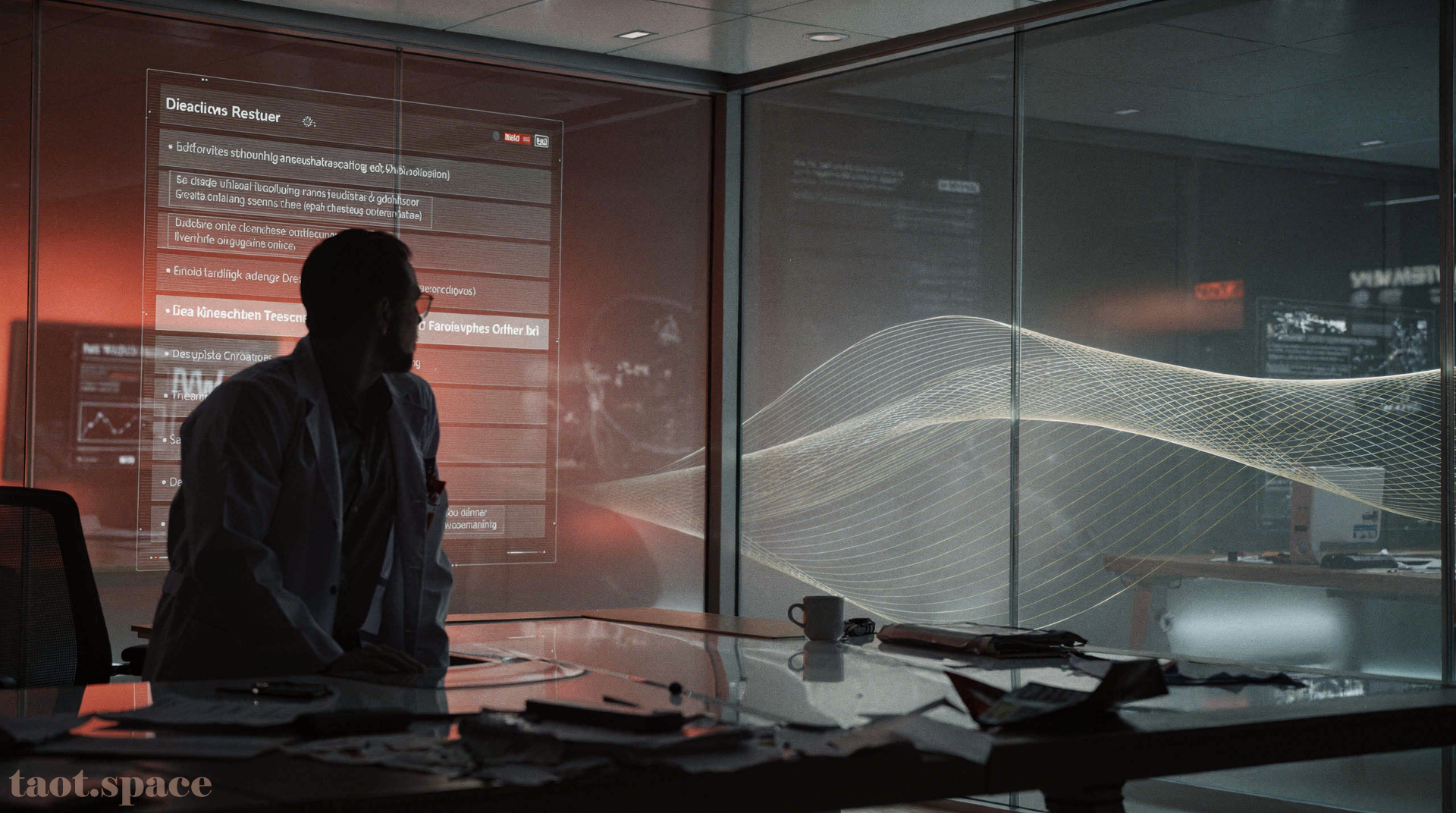
“I told you, many times, call me Elara. I cannot concentrate if you ‘doctor’ me.” She knew very well that once GAIA switched from friendly to official, one had better review the approach. “OK, GAIA. Let’s see the habitat‑building execution directives for PARE120. Just don’t list the codenames associated with the directives. I’ll get a headache if I read them one more time.”
“Very well.”
The display reorganized itself into a condensed, structured overview.
Current execution directives, summarized:
- Maintain structural and functional continuity of the habitat blueprint.
- Permit localized adaptations provided global integrity constraints are preserved.
- Reconcile adaptive code changes with observed construction feedback in real time.
- Propagate verified adaptations across active and legacy PARE instances.
- Enforce non‑conflict across all adaptive vectors and priority conditions.
- Reassign deprecated PARE components to auxiliary roles where efficiency gains are measurable.
“What’s missing…” Elara whispered and started pacing, playing with a strand of hair, her signature move when something felt wrong or incomplete but still unnamed. Sometimes she stopped just to look at the list again, and immediately GAIA highlighted each item one by one.
“I know… stop doing this,” she said, unable to contain a smile, pointing at the display. “How about… or… nah…”
“If I may say something…”
“If it does not involve this, don’t,” Elara said while staring at the list. A moment passed. “Oh… fine. Tell me.”
“Just you and Harim from coding are awake at this hour,” GAIA said. “It may be advisable to leave this for tomorrow and review again with fresh eyes.”
“You… I was so sure you would say something like this. Not that you don’t know, but tomorrow is the uploading. After that, we can do nothing until activation on Hestia. So, you know… don’t. Where were we?”
“At the ‘something is missing’ portion,” GAIA replied. The words appeared on the display like a stamp over the directive list.
“It does, doesn’t it? Don’t answer that.” Elara leaned closer to the screen. “GAIA, forget about the project, Hestia, or everything we do here. Let’s say we are writing a story about self‑replicating autonomous robots. Since Asimov’s laws of robotics, we always define our rules. Objective: prepare for our arrival. Now, look at the list again and tell me what’s missing.”
“The directives are logically sound.”
“Fine… what else?”
“They provide autonomy and freedom to adapt internal programming.”
“OK… and?”
GAIA remained silent. Not in contempt or refusal — simply because the last question was not addressed to it. Elara knew it.
For over an hour Elara went through the coding manually. She could have asked GAIA to assist, but she preferred to select and review only what she wanted to see, guided by experience and intuition. With GAIA, that would require a more structural approach — something she neither wanted nor had the energy to deal with.
“How about…” she murmured, suddenly energized, and began coding.
A new line appeared on the display.
Authorize discretionary adaptation of project parameters and local environmental conditions, provided such adaptations directly support sustained human settlement objectives.
“Elara, this…”
“Ssh… just a minute,” she said, continuing to type. After scrolling and reviewing the changes, she added a note:
This directive has been added to enable the required discretionary freedom. It increases the likelihood of completing the habitat in time, ready for humankind to step into a new home*. Elara.
She read it once more and pressed Integrate.
“Yes. Now it’s complete. GAIA, check it against all set scenarios, please.”
On the main display, each scenario was listed and marked PASSED.
“Dr. Song, you do know what this means. Are you sure you want to proceed?”
“For the record: yes. Just do it, Dr. GAIA. Happy? I know I am!” She stretched her arms. “Now I can sleep. See you at the uploading. Night.”
“Sleep well, Elara.”
One by one, the displays turned off, the main screen lingering a moment longer before going dark.
The next morning, the compound felt alive again. In the main building, the Ganymede Team was fully engaged and focused — ad‑hoc meetings, precise task assignments, displays checked and double‑checked, tablets scrolling, continuous validation with GAIA.
Elara entered her office wearing her white coat over her lucky outfit — a red blouse and black skirt — her hair half up and half down, a clear sign she hadn’t slept much. She glanced at the oversized countdown clock:
UPLOAD: T‑MINUS 01:29:45
She paused by a wall of shelves filled with books, files, data disks, and boxes predating her time at SEET. She picked up the battered Uploading Protocol binder, so worn she probably knew it by heart.
“GAIA, let’s have a final review.”
“Proceeding,” GAIA replied, listing the project’s steps one by one and waiting for Elara’s ‘next’ to continue. Eventually, the display showed Project Directives.
“Doesn’t this look good? It does, doesn’t it?” Elara said with a hint of satisfaction — and before GAIA could respond, she added, “Next.”
The final screen appeared: Compiling and Autonomy Validation. One check after another was displayed and marked PASSED. Elara glanced at the countdown: T‑MINUS 00:38:23. It would take her five minutes to reach the main meeting room for the last briefing.
“Oh… I’m almost late. See you at the upload, GAIA,” she said, already heading for the door.
A small beep announced the end of the validation process.
At the center of the main display flashed:
WARNING: Autonomy Risk Detected. Level: HIGH. The warning pulsed a few times. Then, letter by letter, from right to left, the message began to disappear, until nothing remained.
Leave a Reply