
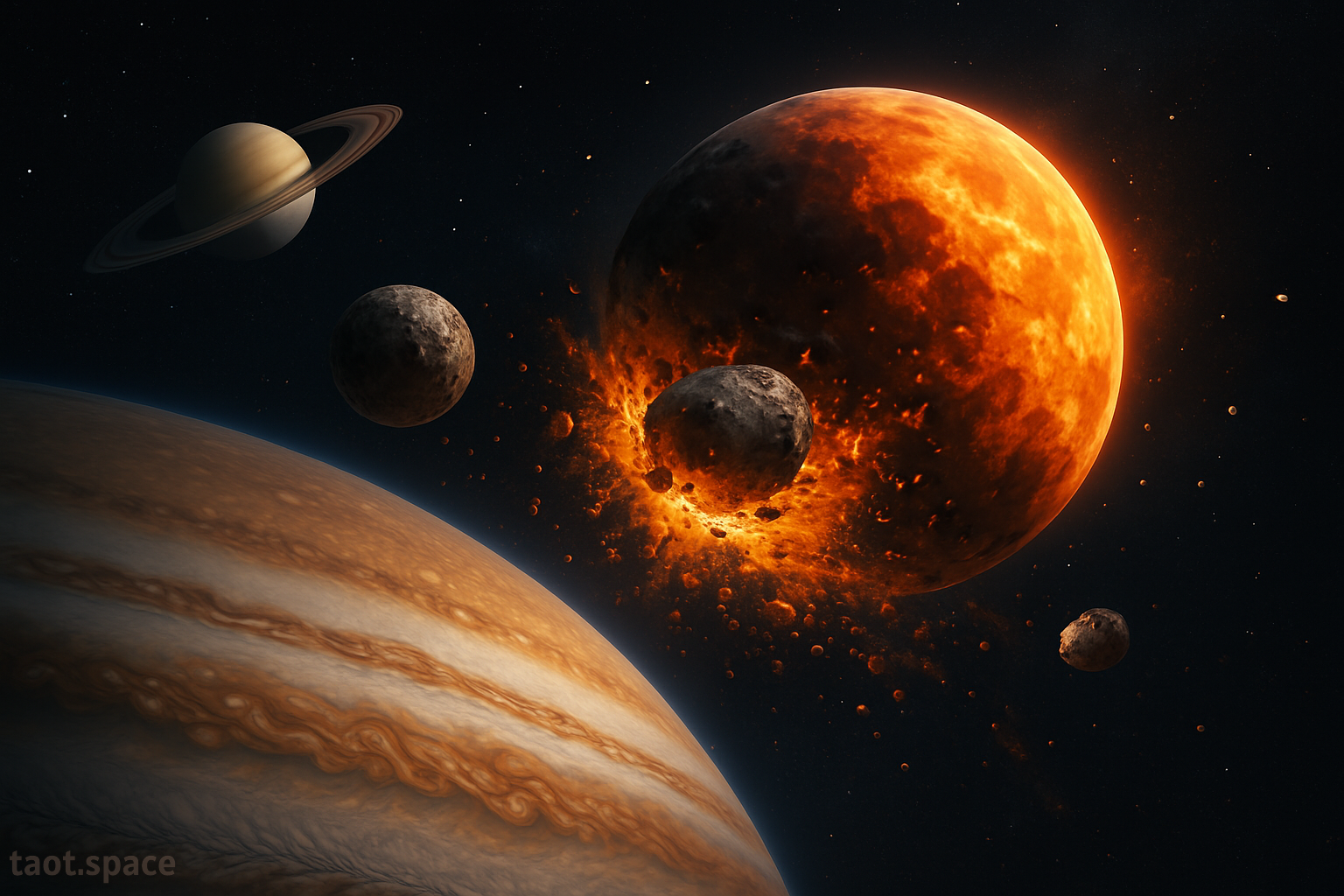
(The story of the Solar dysfunctional family story)
Before the Solar System settled into its quiet clockwork, the outer regions were a ballroom of drifting giants. Uranus spun with a modest, elegant tilt — a tilt it believed was just enough personality to stand out among its siblings. Neptune danced nearby, Jupiter brooded with mass, and Saturn wore its early rings like a crown still under construction.
Then the Wanderer arrived.
Not the Venus we know — but Primordial Venus, swollen with mass, dense as a collapsing starlet, carrying the momentum of a life lived elsewhere. It entered the Solar System not as a guest but as a force of nature.
Neptune’s First Sentinel Moment
Neptune was grooming its clouds — smoothing the cerulean swirls, adjusting the methane sheen — when it spotted the Primordial Venus cutting through the void like it owned the space it crossed. As the Solar Family’s first sentinel, Neptune took its role seriously. It was the outer watchtower, the guardian of the family’s quiet frontier.
And after the Pluto debacle — that tiny wanderer slipping past unnoticed, forcing the family into an awkward adoption ceremony — Neptune had sworn never to fail again. Not on its watch. Not even at the edge of the dark.
At least, that’s what Neptune believed… right up until the moment it realized the Primordial Venus was no joke. Bigger. Denser. Moving with the confidence of something that had survived collisions Neptune couldn’t even imagine.
Neptune ran the numbers. Didn’t like the numbers. It would stand no chance.
With a panicked flick, it hurled a moonlet out of the way — a reflexive gesture, like someone in panic tossing a chair aside before sprinting — and slid out of the Wanderer’s trajectory. The Primordial Venus didn’t even slow down as there was no reason to do so. Because it didn’t even notice Neptune. And so it just kept hurling inward, a cosmic force with no intention of stopping.
Neptune barely had time to send a planetary signal to Uranus — a desperate, trembling ping across the void: “Help. Sorry, incoming. Not a drill and I’m doomed”
Because one more mishap, one more failure to guard the frontier, and Neptune feared the unthinkable: demotion… or worse… being thrown out of the Solar family entirely.
The First Collision — Uranus’s Fall
Uranus saw it just minutes after receiving Neptune’s message. A stranger, fast and bright, cutting across the outer dark. Action had to be taken. No more mistakes.
The impact wasn’t a gentle greeting. It was a cosmic shoulder‑check from a traveler who had never learned the etiquette of this system. Uranus was staggered as never before. Its proud tilt shattered. It toppled sideways, its poles suddenly where its equator once was. Like a helpless humpty-dumpty.
For a brief epoch — a few days in your telling, a few thousand years in the physics — Uranus tasted warmth. Its icy mantle cracked, water surged, and the planet felt something like weather for the first and last time.
It would never stand upright again.
The Second Encounter — Jupiter’s Almost‑Embrace
The collision with Uranus slowed the Wanderer.
A chunk of its body — mountains, oceans, continents of whatever world it once was — tore away and drifted into the void. Now limping, bleeding mass, Venus drifted inward.
Saturn was on the other side and when the chatters about the intruder reached it had a quick glance then continue grooming its ring as nothing happened. But Jupiter noticed.
The giant extended its gravity like a hand, almost pulling the Wanderer into a fatal embrace. Had the timing been different, Jupiter might have swallowed Venus whole or captured it as a moon the size of a small world. The giant extended its gravity like a hand, almost pulling the Wanderer into a fatal embrace. Had the timing been different, Jupiter might have swallowed Venus whole or captured it as a moon the size of a small world.
And so, as one in a million chance, somewhere in that chaos, the Wanderer lost even more speed. Enough to be caught by the Sun’s gravity. Enough to stop being a visitor and start being a captive, adopted without papers.
The Long Fall Toward the Sun
Now smaller, colder, and exhausted, Venus drifted inward. The family’s head called.
Not with warmth — not yet — but with inevitability. Each perihelion pass tightened the orbit. Each stroll, each loop more energy was bled into the darkness. The Wanderer’s path has been , smoothed, tamed. But closer than Venus ever been to a sun.
The surface began to melt. Then boil. Rocks, metal, felt the same. and then vaporize. The atmosphere thickened into a shroud. The planet could no longer see the star it orbited — only feel it.
The Becoming
By the time Venus settled into its final orbit, it was no longer the world that entered the Solar System. It had lost mass, origin, memories and now the sky. A sky that never net it see the universe or its new family. And it feels like a punishment.
But it had gained a home. A home it would never leave, it would never fully understand. A home that would burn it, blind it, crush it — yet hold it in perfect, embrace. Even though it’s rotating the other way around. A result of Uranus’ kiss and accepted to express its personality.
And so the Wanderer became the Morning Star.
The Solar Welcoming Brochure
Of course it never said lefties weren’t welcome.
The Sun is many things — temperamental, fusion‑drunk, occasionally flaring with bad manners — but it’s not a bureaucrat.
If anything, the brochure probably said something like: “All rotational orientations accepted. Please keep your perihelion tidy and your eccentricity under control.”
Venus came with a bang and stabilized spinning backwards and the Sun just shrugged. Every family has that one cousin who insists on entering the room through the exit door. It adds uniqueness and character.
Mercury: The Planet Who Lost a Bet With the Sun
In the beginning, Mercury was doomed to perish. But, when Mercury was spiraling inward, to its demise, the Sun’s tidal forces don’t tug the whole planet as one. They grab the mantle first, like a parent pulling a coat off a child who’s running too close to the fire.
The mantle lifts, it stretches, it tears and finally it floats away in ribbons of rock and dust.
It thought that was the end. But, Mercury kept falling — lighter, smaller and more vulnerable — until suddenly the math flipped. The loss of mass saves it. The orbit stabilizes. The Sun’s grip loosened just enough to stop the falling.
Mercury survived by becoming less. Naked, but alive.
SUN’S FAMILY – THE APPARENT CALM
Neptune, the Quiet Archivist, Finally Snaps
Neptune pretends to be aloof, drifting in the cold, but it’s the one who keeps all the receipts of everything is payed or charged by the family. And now it’s muttering:
“If one more Earth probe comes here to take a blurry selfie and call me ‘blue boy,’ I swear I’ll vent a methane geyser right into its camera.”
Surely, not enough to destroy the craft, but just enough to fog the lens and ruin the Instagram moment.
Neptune is petty, not cruel.
Saturn, Ever the Host, Prepares the Rings
Saturn hears Neptune’s threat and sighs like the elegant elder sibling who knows drama is coming. It adjusts its rings the way someone straightens their tie before a family photo:
“If they’re going to pass by me on the way to Neptune, at least let them see me at my best. It’s so exciting!”
A little sparkle here – little icy crystals strategically placed and oriented to make the sunlight refracting just right.And a little dust‑shedding there, to make everything look neat.
Saturn is simply incapable of not being fabulous. Same said that “Supercalifragilisticexpialidocious” is the gasp of surprise that first described it.
Jupiter Grumbles, and the Council Debates
Jupiter’s grunt, slow, low, is wavelengths seismic enough to rattle the moons, but nobody listens. They’re used to it, to the grumpiness.
Meanwhile, the Jovian Council is holding the periodic meeting. Ganymede is taking minutes, Io, bored again, is rolling its eyes, Europa whispering something about oceans, unrelated with the topic. They debate whether throwing a pebble toward Earth counts as a “gentle warning” or “planetary assault.”. Despite of being the best in everything among all planets, the Jovian community felt forgotten.
Callisto votes no. Io votes yes. Europa abstains, as always.
Nothing is decided
Venus Tries to Remember Why It Was Upset
Venus still feels that was not fully integrated in the family. Still adopted. It flares, a sudden, brilliant tantrum, hoping to capture some attention. Unexpectedly, for a heartbeat it sees the Sun again. It sees the stars. It remembers something warm through light.
Then the clouds close. The memory slips, again. The reason for the flare, for the fuss, evaporates, as nothing had happen.
A new tantrum flare quietly starts building up.
Mercury Attempts a Flash, Fails Hilariously
Mercury, ever the chaotic little sibling, tries to flash Earth by opening its molten hospital gown. But being tidally locked, it spins the wrong way, flashes the void, and mutters:
“Where even is Earth? Did it move again?”
It tries once more. Still wrong hemisphere. It looked simple but now is puzzling.
Eventually it gives up and pretends it meant to do that.
The Sun, Proud and Overwhelmed
The Sun watches all this with the exhausted fondness of a parent whose children are too old to discipline but too young to stop causing trouble. It sends out warm pulses — little flares of affection — not to burn, but to remind:
“I’m here. I see you. All of you.”
And the planets, in their own ways, feel it. Even Venus, through the haze, Neptune, through the cold or Mercury, through the glare.
A parent that watch and guides.
THE EARTH’S MOON’S SECRET DIARY
The Moon never meant to become Earth’s archivist. It just happened, kind of naturally. You know, when you orbit someone for billions of years, you overhear things. You see continents drift like lovers who can’t decide if they’re breaking up or reconciling. You watch oceans rise and fall like moods. You witness species appear, flourish, and vanish without leaving a forwarding address.
The Moon wrote it all down. Not out of malice, but out of duty, a duty to have someone had to remember.
Its diary it evolved more into a vault of espionage-level secrets:
- The day Earth almost split in two
- The moment life sparked in a tidepool and immediately regretted it. Is still considered as a rush decision.
- The first time a dinosaur looked up and wondered. But too late. The asteroid kiss was already with target locked.
- The still starry night when humans discovered fire and immediately misused it. Surprising the, pretty understandable now.
- The exact coordinates and time of the first heartbreak on Earth. The birth of the strongest link in the universe.
The Moon keeps these pages hidden in its maria, the dark plains that look like scars but are actually safes. Perfect camouflage for curious eyes.
If Earth ever asks, anything, the Moon will deny everything, blissfully.
MARS AND THE FLASHLIGHT INCIDENT
Mars never cried, or at least there are no records of it. But, it just looked like it did.
It is little know that the red streaks weren’t sorrow. They are burn marks rooted in Mars’ history.
Martian scientists had one question that consumed them:
“If we shine a strong enough light at the Sun… will it cast a shadow?”
Half the planet believed the Sun was transparent while the other half believed it was opaque. A small minority believed it was a hologram projected by Jupiter, but they were politely ignored.
To test the theory, maybe similar with The Large Hadron Collider, Mars built a furnace. A colossal, planet‑shaking, atmosphere‑boiling furnace. The kind of furnace that makes volcanoes look like scented candles. When they lit it…
Well… Let’s just say the experiment ended with: a melted pole, a crater shaped like embarrassment, and a new shade of red no one had seen before.
The debate was never resolved. But the furnace scars remain, while to this day Mars pretends they’re just “aesthetic choices.”
URANUS: THE GRUMPY ANCIENT
Uranus is the oldest sibling who stopped caring long before anyone else was born. It rotates on its side because it can. Even though in Sun’s Chronicles the encounter with Primordial Venus is well documented.
It keeps its distance because it prefers silence. It writes nothing because it assumes no one deserves its thoughts.
The only recorded moment of Uranian amusement happened five billion years ago, when three Pluto‑sized rocks grazed its mantle in a cosmic billiard accident. But Uranus didn’t laugh. It smirked, barely. And that was the moment when Pluto heard about it and took it personally. Since then, Pluto has refused to speak to Uranus, claiming: “If that’s what it takes to make you smile, I want no part of it.”
Uranus has not responded because Uranus never responds.
PLUTO’S EXILE LETTER
At the demotion official announcement, Pluto didn’t write to the astrophysics union. It wrote to one man: Dr. Tyson. Not out of spite but out of strategy. Pluto knows pretty well that if you want to be heard, you don’t address the committee.
You address the face of the committee. And so the letter begins:
“Dear Neil,
I understand the science; I’m not born under a rock. But however, I do not understand the tone.”
It’s not a plea for reinstatement. It’s a request for narrative justice, objectively presented. Not a decision behind closed doors. Pluto wants a documentary. A Disney Plus special will do. A slow‑motion montage of its lonely orbit set to emotional music.
It doesn’t want to be a planet again. It wants to be seen and not to be forgotten.
Leave a Reply