
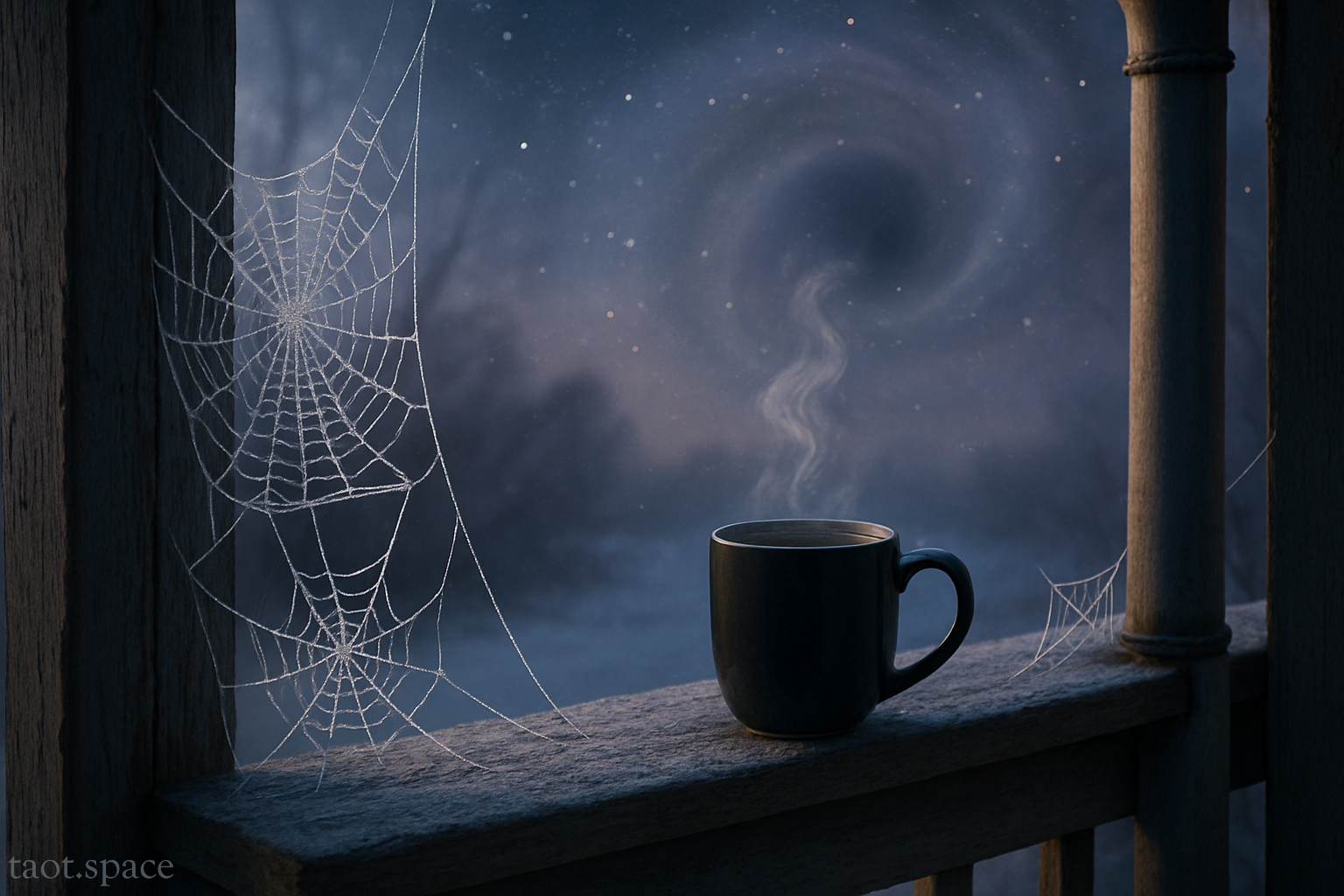
It’s February. First day, to be exact. And it’s cold. And I know it because I’m sitting on the porch. People say it’s warmer than it should be for this time of year, but when you’re on a frozen porch, “warmer than it should” doesn’t mean much, really. And when the wind greets you with a few sharp gusts, you start wondering what that phrase even means.
But the coffee is hot. The air is clean. And the quiet of a Sunday morning feels refreshing and strangely inspirational.
Then my eyes caught a rare sight: a double spiderweb.
Wait a minute. Don’t judge me! Yes, it should’ve been cleared since summer, and yes, the porch is a mess. You might be right, but my priorities were elsewhere. Let’s just say I prefer a wild garden to a perfectly shaped-trimmed, unnatural one. Work with me on this.
So, as I was saying: a double spiderweb. One web stretched between the rain drain pipe, leading into a small tunnel where I imagine the missing spider waits for prey. The other web hung between two fence boards separating my yard from the neighbor’s. And then it hit me, harder than the February air.
What if black holes aren’t solitary? What if they’re born in pairs, like these webs — two ends of the same tunnel in the same space? An Einstein–Rosen bridge not leading to another universe, not to some ephemeral white-hole, but simply to another region of this universe?
Just think about it.
I know, I know! An Einstein–Rosen bridge requires exotic matter to stay open. But is that all? Isn’t that like saying combustion engines only work with gasoline and nothing else ever will? And who said dark matter couldn’t become the “exotic matter” that feeds the tunnel? Or maybe, on a cosmic scale, these tunnels are simply the large scale version of quantum tunnels — ephemeral to the cosmos, billions of years to us.
Stay with me, because I think I though this through and I’m about to bend the physics.
Once a black hole forms, it bends spacetime so intensely that it fuses with it at the quantum level, The level where spacetime is a foam, where quantum black holes flicker in and out of existence in a Brownian symphony. When the fusion happens, the black hole feeds these quantum holes one after another. The tunnel grows through spacetime so fast that even light would feel stationary. It follows the “path of least resistance,” weaving between gravity wells and spacetime ripples until it finds an exit. That exit could be somewhere in the known universe… or far beyond our little observable bubble. Just because at a certain curvature, spacetime stops behaving like a fabric. It becomes a fluid. And that’s just the beginning.
This is a two way tunnel. What one black hole eats is digested into an unnamed radiation phase and exhaled as Hawking radiation. Information enters from the sides and exits through the middle. Isn’t that beautiful? Doesn’t it explain why Hawking radiation can remain strong even when there’s no obvious “feeding”? Because the feeding might be happening on the other side of the tunnel.
It’s like a cosmic metabolism — matter digested down to information and scattered into the cosmic winds on the other side.
And then I wondered… if this were true, how would physics, astrophysics, and quantum theory change? What if we could map these tunnels? Not to travel through — they digest matter — but simply to see them. To understand their shape.
So I tried to visualize it. Not because I’ve seen countless black holes or the whole universe, but because imagination doesn’t care about boundaries or laws. Imagination is the only thing that can entertain itself and never get bored.
And I saw the black hole network. It was beautiful — and strikingly similar to a magnetic field.
“Could it really be this simple?” I asked myself. And the answer came quickly: “Why not?”
What are we from the cosmos’ perspective? Maybe we are to the universe what the Planck scale is to us. And if we were at the Planck scale, we’d realise the graviton isn’t just a particle — it’s the geometry of the field lines. Spacetime foam becomes a fluid. And time becomes even more relative than relativity itself.
And so, the coffee is almost cold now, the cigarette almost finished, and February’s chill is knocking at my bones. I head back inside with this thought — this unfolding perspective — shifting my mental size trying to see imagination from different angles.
And with the last sip of coffee, another idea lands: If we are particle sized to the cosmos, and if the universe has a magnetic like field created by these paired black holes, how would it look from the universe’s perspective?
Well… think about it. Galaxies might be a cosmic version for electrons, clusters might be quarks, superclusters the atoms, and the cosmic web the lattice. How’s that sounds?
And us, humans, what we would be then? Well… just fluctuation. Weak fluctuations living inside a fluctuation.
Some food for thought on a silent, cold winter morning.
Leave a Reply